
The same fire that heals you is the one aging you.
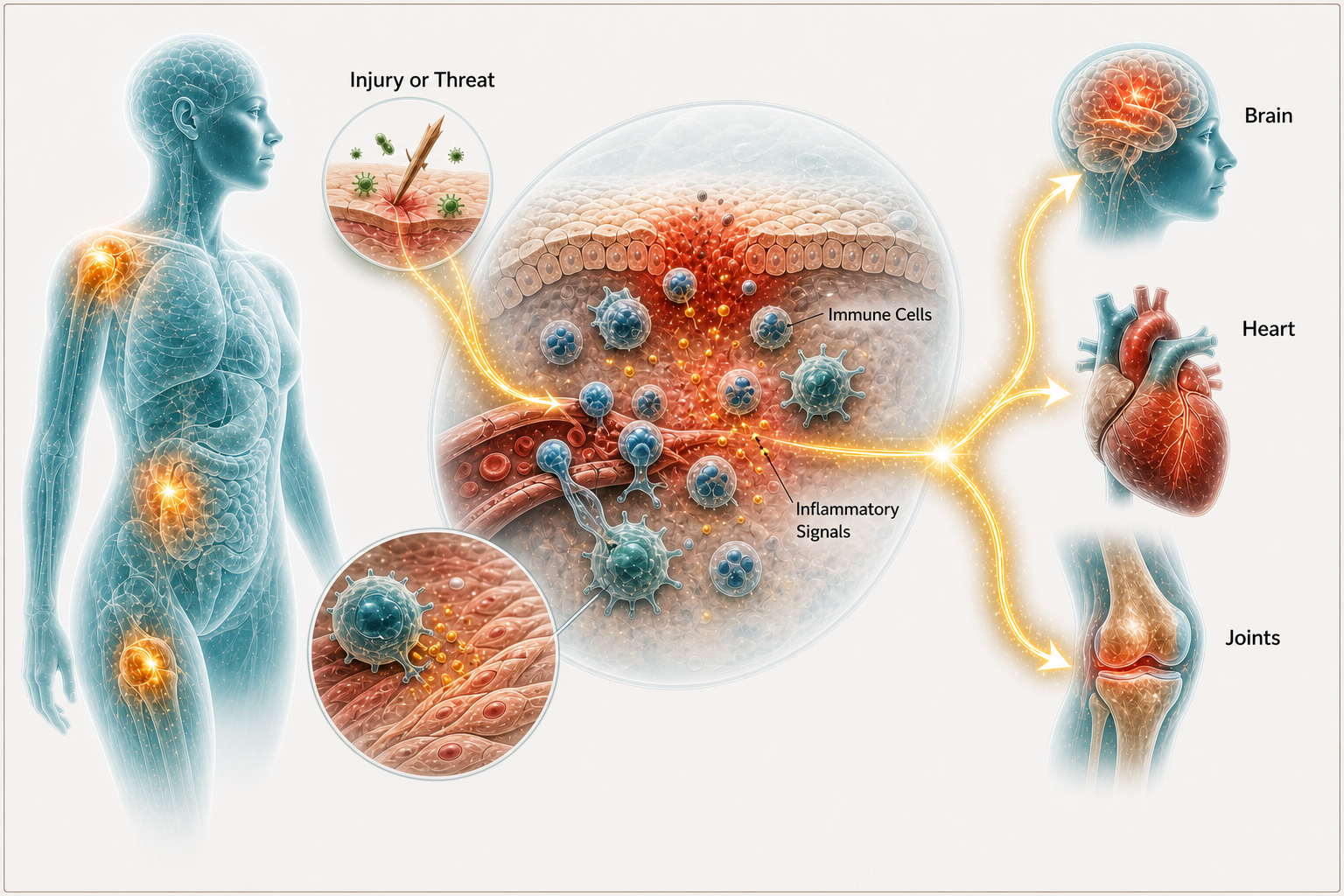
Inflammation is not the enemy. It is how your body heals a wound and clears an infection. The problem is a body that never puts the fire out, and the reason is rarely one thing. It is how the pieces talk to each other.
Inflammation is having a moment. It made the cover of The New York Times Magazine this summer, and the attention is deserved: a growing body of research ties a low, chronic version of it to heart disease, dementia, diabetes, and the general wear of aging. Most of what you read points at food and the body, and that is not wrong. What you eat and how you move are among the largest levers you have on inflammation, and we stand fully behind that.
What usually gets left out is the layer that ties those levers together. Your nervous system is the conductor. It determines whether you actually break down the good food you eat, whether your body can use the movement you give it, and whether the fire settles or keeps burning. Diet and calm are not competing strategies. They are the same conversation.
We have said it for years: inflammation regulation is the key to life. Here is how the whole system fits together, and what to do about it.
Two fires, and why you should not put one out
Acute inflammation is one of the best things your body does. Cut your finger and the heat and swelling are your immune system rushing in to heal it. It flares, finishes, and shuts itself off. Chronic inflammation is the opposite: a low flame that never fully goes out, quiet enough to ignore but hot enough to damage your arteries, brain, and joints for years. Researchers call the version that builds with age inflammaging.
That distinction changes the whole goal. The aim isn’t to suppress inflammation. You need the acute kind, and blunting it across the board is its own kind of harm.
You are not trying to put the fire out. You are trying to convince your body it no longer needs to keep it burning.
It is driving the disease, not just riding along
For years this was a chicken-and-egg question: is sick tissue inflamed because inflammation caused the damage, or does inflammation just show up alongside it? A 2017 trial called CANTOS settled it. A drug that does nothing but lower one inflammatory signal, changing nothing about cholesterol or blood pressure, cut the rate of second heart attacks. Lowering inflammation alone reduced the disease. As one Harvard cardiologist put it, "We all study the same disease." That same fingerprint now runs through heart disease, diabetes, Alzheimer's, and depression, and even the new GLP-1 drugs appear to work partly by cooling inflammation, not only by trimming weight.
Where the smolder starts
Most of the smolder comes from ordinary habits: a processed diet, more alcohol than your liver wants, and too little movement all keep the fire quietly lit. On top of that, aging adds its own. Some worn-out cells stop dividing but refuse to die, and these senescent "zombie" cells sit in your tissues and leak a steady stream of inflammatory signals, which a 2026 Mayo Clinic study in Nature traced to the cells' own failing mitochondria, the engines we spent August on. The fat packed deep around your organs adds more, behaving less like storage and more like a gland that secretes inflammatory messengers.
All of that is real, and most of it runs through what you eat, what you drink, and how you move, which is exactly why those are such powerful levers. What decides whether those signals settle or keep amplifying is the system sitting over the top of them.
The conductor: your nervous system ties it together
If you have worked with us, you have heard us describe the nervous system as a glass. Simply keeping you alive fills it about two-thirds. Work, worry, poor sleep, screens, and old injuries keep topping it up, and when it overflows, the body reads life as a standing emergency. We call that neurological overload, and it sets the terms for everything else on this list.
How a worry becomes a molecule
Psychological stress does not just make the fire harder to put out. It lights it. In lab studies, a purely mental stressor, something as simple as a timed speech in front of a cold-faced audience, raises interleukin-6, one of the body's main inflammatory signals, within an hour or two. No wound, no germ, just a threat in the mind, and the blood inflames. One well-mapped path is direct: fight-or-flight chemicals like adrenaline land on receptors that sit right on your immune cells, and the message they deliver is to switch on the genes that produce inflammation. And the effect outlasts the moment. People carrying long-running stress, loneliness, grief, a job that never lets up, show the same shift written into the gene activity of their white blood cells.
Why would the body do something so self-defeating? Because for most of human history, a threat meant a possible injury, and an injury meant infection. Mobilizing inflammation before the wound arrived was smart preparation. Your immune system still follows that ancient order. It cannot tell a predator from a deadline, so it preps for a wound that never comes, day after day, and over time that standing preparation can itself become the damage.
And that is only the gas pedal. Chronic stress also wears out the brake. Under stress, your body releases cortisol, which in short bursts actually calms inflammation. But when the stress never lets up, the immune system goes deaf to cortisol's signal, a state called glucocorticoid resistance. Once the brake fails, the fire is free to burn. This is why the same clean meal does more for a calm body than a frazzled one, and why the person eating an immaculate diet who is still wired, underslept, and braced against their own life often stays inflamed anyway. The food is right. The body is too alarmed to use it fully.
A clean plate lands differently in a body that feels safe.
The two-way street you can feel: your gut and your emotions
The clearest place to watch this play out is digestion, because you can feel it happening. Breaking food down is a "rest and digest" job, run by the calm side of your nervous system. A body stuck in fight or flight does the opposite of resting, so it throttles digestion down, slowing stomach acid, enzymes, and the muscular squeeze that moves a meal along. In other people, the same alarm runs the opposite direction and hurries everything through: the stomach slows but the lower gut speeds up, stools turn loose, and the meal is pushed out before much of it can be absorbed. Slowed or rushed, the result is the same: a digestive system no longer setting its own pace. Either way, food arrives downstream half-broken down, feeding the wrong bacteria and irritating the gut lining, and an irritated gut becomes its own source of inflammation. Stress can turn good food into a problem before it is ever absorbed.
The wire that carries all of this is the vagus nerve, the long cable running from your brainstem down through the chest and into the gut. It is the main line into the calm, parasympathetic side of your nervous system, and it runs in both directions. It tells digestion to switch on, and it carries the gut's report back up to the brain, which is a real part of why a churning stomach and a churning mind so often show up together. It also speaks directly to the fire: researchers have mapped a circuit called the inflammatory reflex, in which the vagus senses inflammation rising and signals the immune system to throttle it back. A well-toned vagus tends to run alongside lower inflammation in the blood.
So the loop closes. Your emotions change how you digest, your digestion changes how you feel, and inflammation is a good part of what the two say to each other when the message is stress. Calm the system, and you digest better; digest better, and the system calms. That is the integration, and it is why the next piece is not a soft add-on.
Food and calm are not two strategies. They are the same conversation.
The number you can actually check
Here is where it turns practical, because the state of that system is measurable. How much carbon dioxide you can calmly tolerate is a physical readout of how twitchy your internal alarm is. Decades ago, the psychiatrist Donald Klein proposed that anxiety-prone people carry a hypersensitive "suffocation alarm" that misreads a normal rise in CO2 as a threat. A 2026 meta-analysis in Biological Psychology quantified it. A shorter comfortable breath-hold, a simple proxy for low CO2 tolerance, tracked with greater anxiety-related vulnerability. A body that panics at a little CO2 is a body living next to its own alarm, and that same nervous system keeps the fire lit and holds your digestion down.
The encouraging part is that this number moves. A slow, extended exhale is one of the few direct switches you have into the calm side of your nervous system, the same switch that lets your gut get back to work, and, trained a few minutes a day, it raises your CO2 tolerance and resets your default away from a constant signal of danger. That is the whole idea behind PNEO: it measures your CO2 tolerance, then trains it up.
Start by finding out how hot your fire is
Our two-minute check scores your inflammation load, measures your CO2 tolerance on the spot, and tells you the one lever that will cool it fastest.
Take the quiz: How hot is your fire? →
Do this: Test your CO2 tolerance in the quiz, then train it in PNEO, free on the App Store or Google Play. For the fuller picture of what is filling your glass, take the Neurological Load Assessment.
Eat and move with the system, not around it
Once you see the loop, food and movement stop being a separate checklist and become the other half of the same message: you are safe, you can put the fire down. And they carry real weight on their own. Nothing touches the inflammation dial as often as your fork. Ultra-processed food is the clearest, best-proven driver on the list, while real food cools it: whole ingredients, a clean cooking oil (avocado for a hot pan, olive to finish), and a plate built mostly from vegetables and other whole plants, which also feeds the gut bacteria that talk back to your nervous system. Movement lowers inflammatory markers directly and burns off the visceral fat that pumps them out, and it drains the glass at the same time, but only the kind you will actually keep doing, which is exactly what Kele's new Movement by Design course is built to make possible.
Do this: Cook one of the two stir-fries below tonight, and join the Movement by Design waitlist, where the live beta cohort is free.
If you want targeted backup, three from Designs for Health cover most of it: OmegAvail Hi-Po for omega-3s, Inflammatone for curcumin, ginger, and boswellia, and DigestZymes to help a stressed, slowed gut actually break a meal down. Use code FIRE15 at checkout.
Two anti-inflammatory stir-fries
Fast, clean, and built on the ideas above. Ginger, garlic, and turmeric are not garnish here. Each has real anti-inflammatory evidence behind it, and turmeric works far better with a crack of black pepper, so we always pair them. Build either bowl on cauliflower rice or a scoop of organic short-grain rice.
The Meat Version: Grass-Fed Beef & Broccoli Stir-Fry
Serves 2 to 3 · About 25 minutes
For the bowl
1 lb grass-fed flank or sirloin steak, thinly sliced against the grain
2 tbsp avocado oil, divided (the high-heat oil)
1 large head broccoli, cut into small florets
1 red bell pepper, sliced
2 cups shiitake or cremini mushrooms, sliced
4 cloves garlic, minced
2 tbsp fresh ginger, grated
4 scallions, cut into 1-inch pieces
For the sauce
3 tbsp coconut aminos or low-sodium tamari
1 tbsp rice vinegar
1 tsp ground turmeric
1/2 tsp black pepper (turns the turmeric on)
1 tsp raw honey, optional
1 tsp toasted sesame oil, to finish off the heat
Method
Whisk the sauce ingredients together and set aside.
Heat 1 tbsp avocado oil in a wok or large pan over high heat. Sear the beef in a single layer, about 1 to 2 minutes per side, then remove it to a plate. Do not crowd the pan.
Add the second tbsp of oil. Stir-fry the broccoli, pepper, and mushrooms for 4 to 5 minutes, until bright and just tender.
Add the garlic, ginger, and scallions and toss for 60 seconds, until fragrant.
Return the beef and any juices to the pan, pour in the sauce, and toss for another minute until everything is glossy and hot. Serve over cauliflower rice or organic rice.
The Vegetarian Version: Tempeh & Bok Choy Stir-Fry
Serves 2 to 3 · About 25 minutes
For the bowl
1 8-oz block organic tempeh, cut into thin slabs or cubes
2 tbsp avocado oil, divided
2 heads baby bok choy, chopped
1 cup snap peas or green beans
1 carrot, thinly sliced
2 cups shiitake mushrooms, sliced
4 cloves garlic, minced
2 tbsp fresh ginger, grated
4 scallions, cut into 1-inch pieces
For the sauce
3 tbsp coconut aminos or low-sodium tamari
1 tbsp rice vinegar
1 tsp ground turmeric
1/2 tsp black pepper
1 tsp raw honey or maple syrup, optional
1 tsp toasted sesame oil, to finish
Method
Steam or simmer the tempeh for 8 to 10 minutes first. This mellows its bitterness and helps it soak up the sauce. Pat dry.
Whisk the sauce ingredients together and set aside.
Heat 1 tbsp avocado oil over high heat and brown the tempeh on all sides, about 4 minutes. Remove to a plate.
Add the second tbsp of oil. Stir-fry the carrot, snap peas, and mushrooms for 3 minutes, then add the bok choy for 2 more.
Add the garlic, ginger, and scallions and toss for 60 seconds. Return the tempeh, pour in the sauce, and toss for a final minute. Serve over cauliflower rice or organic rice.
One note on the tempeh: it is fermented soy, and the fermentation breaks the beans down before you cook them, which makes it far easier to digest than most soy and a rare plant protein that works with your gut rather than against it.
Want a month of these? Anti-Inflammatory 30
These two are a start. We put the full month together: thirty anti-inflammatory dinners, one a night, every one gluten-free, dairy-free, and built to at least 40 grams of protein, each with a photo, the macros, and a short note on why it helps. No shellfish, no guesswork, simple weeknight cooking.
Launch price $9 this month, then $19. Get the 30-dinner book →
Regulate the fire, one signal at a time
Chronic inflammation is not a single enemy to be defeated. It is a body that has been told, over and over, that it is not safe, and it answers the way it was taught, gradually, through what becomes normal for you. So the work is not to attack the fire from one direction. It is to send the opposite signal from every direction at once, until your body believes it: a slower breath, a calmer gut, a real night's sleep, a plate of food it recognizes, movement it can trust. Each one makes the next one land better. Do that consistently and the fire has less and less reason to burn. Because inflammation regulation is the key to life.
Cook something clean tonight. Your future self is paying attention.
Fred & Kele
The deeper science- the brain and microglia, the gut second front in full, and a brain lipid you can actually test- is coming in a companion deep dive.