
The pain is real. The source may not be where you think.
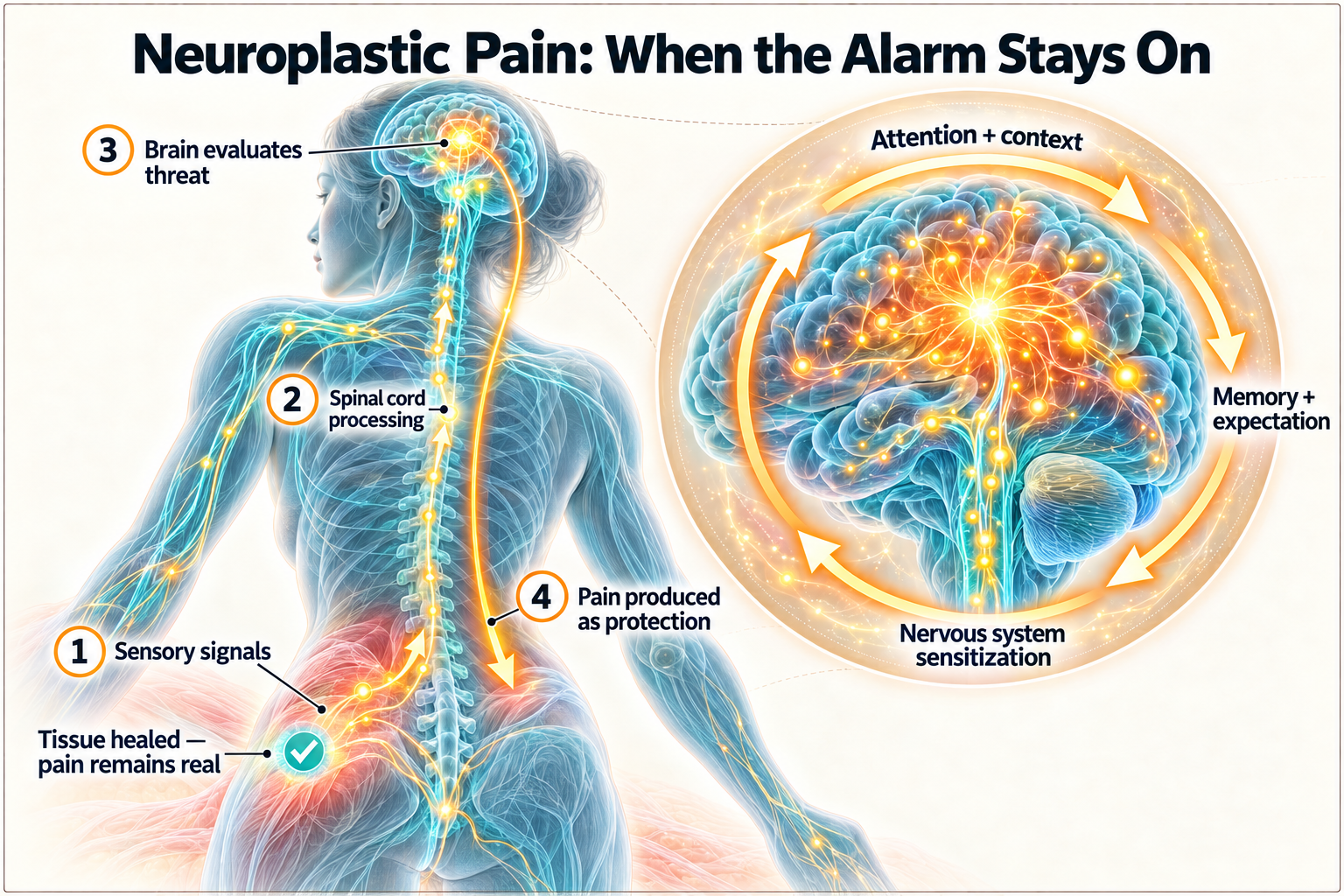
Since June we have been describing a nervous system that never gets told it is safe. Pain is the clearest example, so we saved it for last. Pain, including the kind that shows up on a scan, passes through a decision your brain makes about danger. That decision can be changed, even when the scan cannot.
June named the glass, a nervous system filled past its rim. July was muscle, August the mitochondria that power it, September the inflammation that stays lit because the alarm never stands down. Chronic pain is where all of it shows up in plain sight. Pain is your brain's judgment about whether you are safe. That line comes straight out of the research, and the studies below show how.
Pain is made in the brain
After an amputation, somewhere between half and four in five people feel pain in the limb that is gone. There is no tissue left to hurt. The brain still holds a map of the missing part, still treats it as under threat, and the pain it makes is real.
Now the reverse. In 1995 the British Medical Journal reported on a builder who jumped onto a six-inch nail that went through his boot. He was in so much pain that the emergency staff sedated him to pull it out. When they took the boot off, the nail had passed between his toes. The foot was untouched. His brain saw the nail, decided the foot was pierced, and made the pain to match.
Pain is real. It is also an opinion your brain forms about danger, and it can be wrong in either direction.
Your scan is not your sentence
When researchers scan people with no pain at all, they find damage everywhere. A 2015 review pooled imaging from more than three thousand pain-free adults: disc degeneration in 37 percent of 20-year-olds and 96 percent of 80-year-olds. Rotator cuff tears in a third of pain-free shoulders, and in more than half over 60. MRI abnormalities in nearly nine of ten knees over 50, whether or not the knee hurt. Even the plantar fascia shows the thickening that gets called plantar fasciitis in a small share of people who have never had heel pain. A finding on a scan is common, it is often just aging, and by itself it does not tell you why you hurt.
The Boulder study, below, made the point directly. Twenty of the patients it treated had been scanned before enrolling, and every scan showed a spinal abnormality. Two thirds of the treated group ended up pain-free or nearly so. The disc was still there. The pain was not.
The filter your brain reads everything through
The same disc can hurt one person and leave another alone, because the brain does not read the body raw. A signal from your low back arrives alongside your history: the parent who had back surgery, the doctor who said "degenerative," the year you were afraid to lift your kid, the stress you carried when it first flared. The brain weighs the signal against all of that and decides how much danger it represents. That decision is the pain. It is why a 2023 meta-analysis of more than 800,000 adults found that four or more adverse childhood experiences nearly doubled the odds of chronic pain in adulthood. Those childhoods left the spine alone and taught the nervous system that the world is dangerous.
Your brain interprets your body through the filter of your life. Change the filter, and the same signal can stop hurting.
Not only pain: the "mystery" symptoms follow the same rule
Pain is the clearest case, but the brain runs the same judgment on every signal the body sends. Migraine, irritable bowel, fatigue that sleep does not touch, tinnitus, dizziness, burning skin, food reactions that keep multiplying. A nervous system stuck on threat amplifies ordinary sensations into alarms and turns down the digestion, repair, and immune work it treats as optional in an emergency. Gastroenterologists now classify irritable bowel syndrome as a disorder of gut-brain interaction. "In your head" does not mean imagined. It means the organ producing the symptom is the brain, and the symptom is as real as any other.
The scan rule has a lab-test version. A finding is not automatically the cause. A positive antinuclear antibody, the marker that starts many autoimmune workups, shows up in about one in seven healthy adults. The IgG food sensitivity panels people are handed measure exposure, not intolerance, which is why the allergy societies advise against them. We have watched people spend years and thousands of dollars treating one finding after another while the thing keeping the symptoms going was never in the tube. If your list is long, moves around, and worsens in hard seasons, put the nervous system on the suspect list before the next protocol. Gordon counts several unexplained symptoms as one of his clues, and it is on the quiz below.
Test results are real. Whether a result is causing your symptoms is a separate question, and the nervous system is often the answer.
Fear is the fuel
Alan Gordon runs the Pain Psychology Center in Los Angeles and wrote The Way Out after years of his own chronic pain. His explanation is the simplest we know. Pain grabs attention. Attention brings fear. Fear tells the brain the danger is real, so it turns the pain up. He calls it the pain-fear cycle, and once it is running, the injury can heal completely and the loop keeps going on its own. That is neuroplastic pain, the idea Howard Schubiner introduced in our June issue: a learned pain, wired in by the same plasticity that lets you learn a language.
Gordon's treatment, Pain Reprocessing Therapy, starves the loop by teaching the brain the pain is a false alarm. A University of Colorado Boulder trial published in JAMA Psychiatry in 2021 tested it on 151 adults with chronic back pain, averaging ten years of it: eight sessions over four weeks, against a placebo injection and usual care. 66 percent of the PRT group were pain-free or nearly pain-free after one month, against 20 percent on placebo and 10 percent with usual care. The gains held at one year, and a 2025 follow-up found more than half still nearly or fully pain-free five years later.
Fear keeps the alarm on. Teach the brain the signal is safe, and the pain has less reason to exist.
Four kinds of pain, and most of us carry more than one
Before the quiz, a caution we feel strongly about. The conversation around Gordon's work can leave the impression that every chronic pain is neuroplastic. We do not believe that, and the pain science does not say it. Stanford's pain medicine division sorts chronic pain into four types. Nociceptive pain comes from injured or inflamed tissue, an arthritic joint or a torn tendon. Neuropathic pain comes from damaged nerves. Nociplastic pain, the term the international pain society adopted in 2017 for what Gordon calls neuroplastic, is pain with no clear tissue or nerve damage behind it. The fourth type is mixed: more than one of those running at the same time.
In our experience, mixed is the common case, and the researchers who study pain classification say something close to it. A 2019 consensus paper on the mixed pain concept noted that sorting patients into pure tissue pain or pure nerve pain had left a good share of them unclassified, because so many sit in the overlap. The Boulder trial is honest about this too. It enrolled people whose back pain had no injury or disease a doctor could point to as the cause. Twenty of its patients had scans showing spinal abnormalities and were enrolled anyway, which fits the numbers above: worn discs are the normal state of a middle-aged spine. A joint with no cartilage left is a different animal, and the trial does not claim otherwise.
The scan cuts both ways
We have said a finding on a scan does not prove it is the cause. The reverse holds as well: a clean scan does not prove the tissue is fine. Measured against what surgeons find, imaging is less exact than the report makes it sound. A 2018 review of lumbar disc studies, using surgery as the reference, put MRI right about eight times in ten, with what the authors called a large share of false positives and false negatives. For knee cartilage, a 2024 meta-analysis of 43 studies found that standard MRI caught about six in ten of the cartilage lesions surgeons found at arthroscopy, rising to roughly eight in ten on the newest machines. Call it seven or eight times in ten, depending on the joint and the magnet. In that lumbar review the scan missed real damage about as often as it flagged something that was not there.
That matters for the person reading a normal report while the knee swells every afternoon, and for the person told a worn disc explains everything. In both cases the picture is a clue. The tissue still has to be examined by hand and watched over time under load.
Take the two of us. Kele's ankle and Fred's shoulder are bone on bone, and no amount of brain retraining grows cartilage back. We also know, from years of watching our own pain rise with stress and fall with sleep, that a share of what we feel on a bad day comes from the alarm, with the joint only part of it. That is mixed pain. More on our own scans below.
Why movement is the treatment that fits all four
This is the reason we keep coming back to movement. It is the one treatment that works on the tissue and the alarm at the same time. On the tissue side, load is what tendon, cartilage, and muscle respond to. A Cochrane review of 54 trials in knee osteoarthritis found that exercise cut pain by about 12 points on a 100-point scale, an effect the authors compared to anti-inflammatory drugs, without the pills. A 2021 Cochrane review of 249 trials in chronic low back pain pointed the same way: exercise reduces pain compared with no treatment. On the brain side, every rep you finish without harm is evidence delivered to the alarm that this movement is safe. Somatic tracking makes that argument sitting still. A well-chosen squat makes it with a load on your back.
The dose is the whole art. Too little and the tissue never adapts. Too much and you hand the alarm fresh evidence that you are in danger. The load has to be honest about the joint and still tell the nervous system you are safe to move. Finding that load, for each person and each joint, is the work we do.
Mixed pain is the rule we see in the clinic. Work the tissue and the alarm, and move, because movement does both at once.
Is your pain neuroplastic?
Gordon lays out the clues that point toward a learned pain rather than a structural one: when it started, how it moves, what sets it off, and who you are. We turned them into a two-minute self-check that tells you whether to start with the alarm, the tissue, or both.
Take the quiz: Is your pain neuroplastic? →
Three things to do this week
The first two come from the PRT approach used in Boulder. The third is a practice from our own mornings. They all go better if the alarm is already turned down, so start with a slow exhale in PNEO.
1. Somatic tracking
Sit comfortably. Bring your attention to the pain on purpose and describe it the way a curious scientist would: Where is it, exactly? Sharp, or more of a dull pressure? Does it move when you pay attention to it? No bracing, no wishing it away. The goal is to show your brain, in real time, that you can look straight at the sensation and nothing bad happens. Two or three minutes. Every time the signal fires, the message you send back is: I see you, and I am safe.
2. The evidence sheet
Fear needs a story, usually "something is wrong in there." Write down every fact that argues against it. It moves. It is worse on stressful days. It started during a hard year, not a fall. It disappears when you are absorbed in something. The scan shows what everyone's shows at your age. Keep the list on your phone, and when the fear speaks, read it.
3. Trust Your Body
Kele built this ten-minute practice, and both of us do it every morning. We have turned it into a page you can use. Arrive with a hand on the chest and one on the belly. Come home to the body and look at one sensation the way somatic tracking teaches. Name how you want to feel. Choose an affirmation the body can believe. Ask to be shown how you created safety, healing, and ease, as though it has already happened. Pick one way to practice trust today, and one truth to carry. Ten minutes that tell a nervous system it is safe, before the day has an opinion about you. There is a guided version with a timer, or read it as a script and print it. Start the Trust Your Body practice.
Do this: Take the quiz, then run somatic tracking once a day for a week. If you want the whole ten minutes laid out for you, do the Trust Your Body practice each morning instead. Pair it with a slow exhale in PNEO, free on the App Store or Google Play.
We know this one from the inside
We are not writing about pain from a distance. Kele has a bone-on-bone ankle. Fred has a bone-on-bone shoulder. Between the two of us there are thirteen surgeries and more crashes and falls than we can count, and we deal with pain in our bodies every day. Our whole deep dive into optimal aging and natural health was born from our own suffering. What we learned inside the medical system, surgery after surgery, is that it is not built for healthy people. It is built to get you out of danger. If you want a high-level recovery and a return to high-level activity, you have to figure that part out on your own. Understanding these ideas in ourselves, and then in the people we work with, is how we made our careers.
So when we say the scan is not your sentence, we are describing our own scans. The bone-on-bone is real. The pain it produces on any given day still runs through the filter above, and we have learned to work both sides.
When the tissue really is the problem
None of this means it is all in your head. Some pain is structural. Much of it is mixed: a real tissue problem, sometimes one that will not heal on its own, and a brain that learned the pain so well it kept going. Those cases need both sides treated, and movement, dosed well, is the first tool for both.
A tissue that keeps sending a real irritation signal keeps the brain's alarm on. Quiet the tissue and you take away the alarm's best excuse. Retrain the brain and the pain does not outlive the injury. That is how we work in the clinic, on both at once.
For the tissue side, the newest tool in the clinic is focused shockwave with the Zimmer DualWave FX. It sends a pressure wave that comes together at a point below the skin, and we set how deep that point sits, so it reaches a joint, a tendon where it attaches to bone, or old scar tissue that never fully healed. The wave creates a small, controlled stress in tissue that stopped repairing itself, which restarts repair: new blood vessels grow in and the nerve endings that keep sending the irritation signal get reset. That is why we treat in a short series of weekly sessions rather than one visit. The research is strongest for plantar fasciitis and calcium deposits in the shoulder, and promising for other tendon and joint problems. We use it on low backs, necks, shoulders, elbows, hips, knees, ankles, and heels, with no needles and little to no downtime. One treatment on Kele's bone-on-bone ankle was the first thing in years that made it better rather than only keeping it from getting worse. Read what it treats, and pricing, on our shockwave page.
Pain that has stopped healing?
If a back, neck, shoulder, elbow, knee, ankle, or heel has been hurting for months, come in and let us look at it. We will help you sort out how much is the tissue, how much is the alarm, and work on both, with focused shockwave on the tissue side.
One nervous system, five issues, one signal
Neurological overload, sarcopenia, failing mitochondria, chronic inflammation, chronic pain: the names are different and the mechanism is one. A body that has been told it is not safe answers with tension, and eventually with pain. So the work is to send the opposite signal from as many directions as you can, until the nervous system believes it. Over the past months that meant breathing slower, building muscle, and eating food your body recognizes. This month it means talking to the alarm directly.
The pain you feel is real. Where it comes from is more negotiable than anyone told you.
Look at the sensation. Then breathe out slowly.
Fred & Kele
Sources: Ashar et al., JAMA Psychiatry, 2022 and 2025 five-year follow-up; Brinjikji et al., AJNR, 2015; Sher et al., JBJS, 1995; Guermazi et al., BMJ, 2012; Fisher, Hassan and O'Connor, BMJ, 1995; Alan Gordon with Alon Ziv, The Way Out, 2021; Bussières et al., European Journal of Psychotraumatology, 2023; Drossman and Hasler, Rome IV, Gastroenterology, 2016; Satoh et al., Arthritis & Rheumatism, 2012; Stapel et al., EAACI Task Force, Allergy, 2008; Gerdesmeyer et al., JAMA, 2003; Gollwitzer et al., Journal of Bone and Joint Surgery, 2015; Kosek et al., Pain, 2016; Freynhagen et al., Current Medical Research and Opinion, 2019; Kim et al., Chiropractic & Manual Therapies, 2018; Chen et al., Arthroscopy, 2024; Fransen et al., Cochrane Database of Systematic Reviews, 2015; Hayden et al., Cochrane Database of Systematic Reviews, 2021.