
You are running on ancient bacteria. Keep them strong.
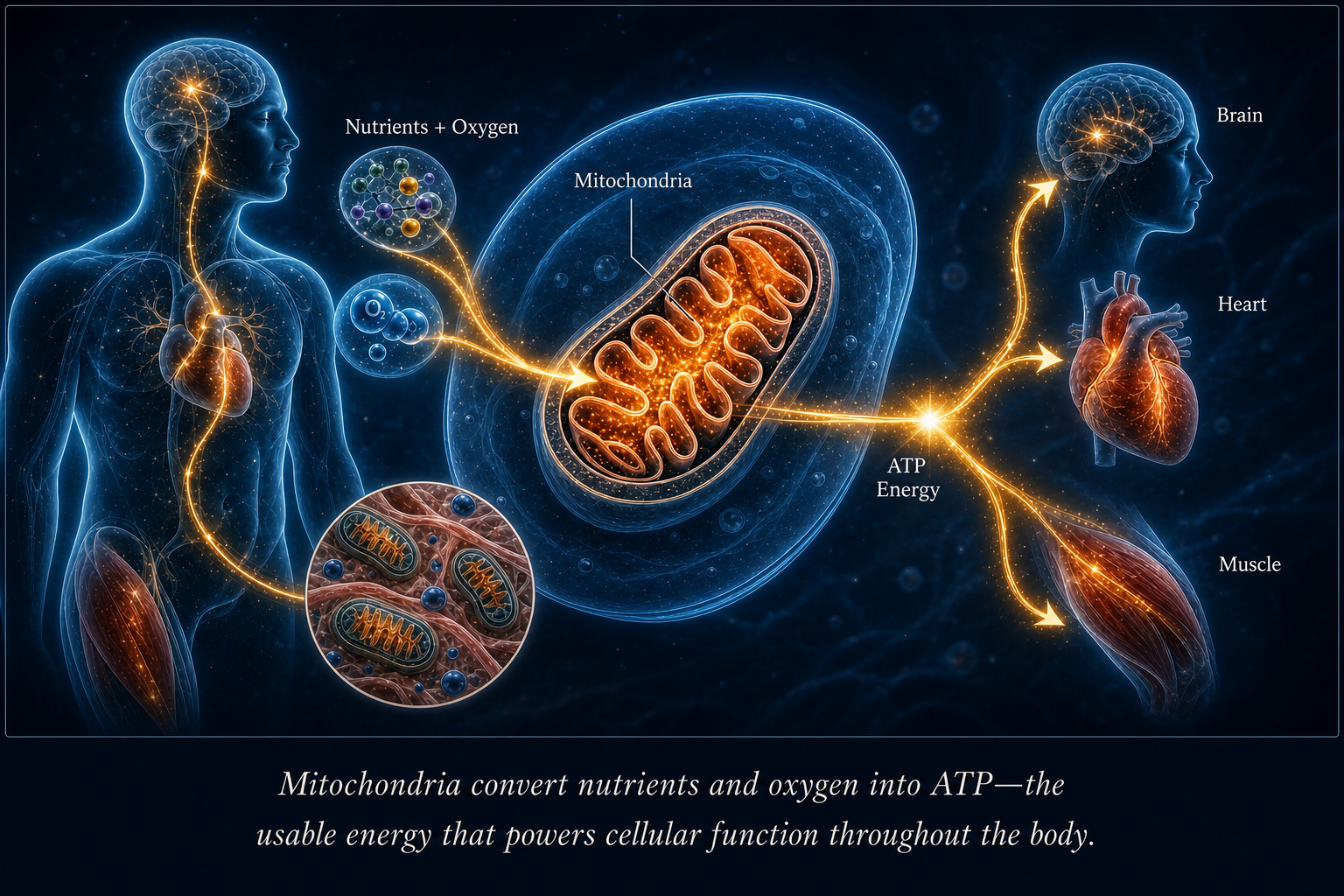
Inside almost every cell you have are tiny engines that decide how much energy you make, how fast you age, and how well your body defends itself. Most people never think about them. They should.
Last month we talked about muscle, and why quietly losing it changes how you age. This month we want to go one layer deeper, into the thing that makes muscle work at all. Because inside every muscle fiber you have, and inside almost every other cell in your body, there are microscopic structures doing the actual labor of keeping you alive. They are called mitochondria. Once you understand what they do, a lot of your own health stops being a mystery. Your energy, your recovery, the brain fog, your risk for most of the chronic diseases we worry about as we get older. It all runs back to them.
This is not a fringe idea anymore. Over the last ten years, mitochondria have gone from a line in a biology textbook to one of the busiest corners of medical research. A lot of noise has come with that, and we will get to some of it. First, what these things actually are.
A two-billion-year-old partnership
Roughly two billion years ago, a simple cell took in a bacterium, and the two struck a deal. The bacterium was brilliant at one thing, turning oxygen into usable energy, and in exchange for shelter it went to work powering its host. Neither of them ever went back to living alone. Every mitochondrion in your body is a direct descendant of that ancient bacterium, still living inside your cells, still holding up its end of the bargain.
This is not a metaphor. Mitochondria carry their own DNA, separate from the DNA in the nucleus of your cells. You inherit that mitochondrial DNA only from your mother, which is why researchers can trace it back through thousands of generations. When a German pathologist named Richard Altmann first described these structures in 1890, he called them "bioblasts" and suggested they might be living organisms in their own right. His colleagues thought he was overreaching. He was closer to the truth than any of them. Eight years later Carl Benda gave them the name we still use, from the Greek words for "thread" and "grain." It took until the 1960s for biologist Lynn Margulis to assemble the evidence that Altmann was essentially right, and the idea, once ridiculed, is now in every biology textbook.
The biochemist Nick Lane, who has spent his career on this question, argues that this one merger is the reason complex life exists at all. Bacteria stayed simple for billions of years because they could never generate enough energy to become more. Only once a cell had mitochondria running inside it could life afford something as expensive as an animal, or a brain. Put bluntly, you exist because a bacterium moved in two billion years ago and never left.
The powerhouse does far more than make power
You may remember mitochondria from school as "the powerhouse of the cell." That is true, and it undersells them badly. Yes, they take the food you eat and the oxygen you breathe and turn them into ATP, the molecule that powers every process in your body. An adult makes and burns through something close to their own body weight in ATP every single day. That alone is remarkable.
But mitochondria also decide when a damaged cell should die, which is one of your body's main defenses against cancer. They help build your hormones. They manage calcium. They act as sensors, reading the state of the cell and sending out signals that shape inflammation and metabolism. Researchers like Dr. Martin Picard at Columbia now describe them less as batteries and more as tiny processors that help coordinate the whole system. When they work well, everything downstream tends to work well. When they falter, the effects show up everywhere at once.
Why "almost all disease is mitochondrial" holds up
The claim that has driven this whole conversation is a big one. Nearly every chronic disease of aging shares a common thread, and that thread is mitochondrial dysfunction. Dr. Douglas Wallace, one of the founders of mitochondrial medicine, has spent his career arguing that if you only look at the DNA in the nucleus, you miss the energy story that connects conditions we usually treat as unrelated.
Think about the list. Type 2 diabetes is a problem of cells that can no longer handle fuel properly. Neurodegenerative diseases like Alzheimer's and Parkinson's show clear signs of failing energy production in brain cells long before symptoms appear. Heart failure is partly a failure of the most mitochondria-dense tissue in the body to keep making energy. Chronic fatigue, many autoimmune conditions, and the general slide of aging itself all trace back, in part, to cells that cannot make enough clean energy. In 2013 a landmark paper listed mitochondrial dysfunction as one of the core hallmarks of aging. It is not that mitochondria cause every disease directly. It is that when your cellular engines run poorly, they create the conditions in which disease takes hold.
When your cells cannot make enough clean energy, the damage does not stay in one place. It shows up as whatever your body is most vulnerable to.
The newest piece: zombie cells and the inflammation they leak
Regular readers have met these before. Last month, in the issue on muscle, we talked about zombie cells, the senescent cells that stop dividing but refuse to die and sit in your tissues leaking inflammation. There the point was that losing muscle lets them pile up and feed a slow, body-wide burn called inflammaging. A July 2026 study from the Mayo Clinic, published in Nature, goes a layer deeper and asks what actually switches that inflammation on. The formal name for what these cells leak is the senescence-associated secretory phenotype, or SASP, and it is now considered one of the engines of aging itself. It feeds the same short list of diseases we just walked through.
The Mayo team went further than naming the problem. They showed that mitochondria are what switch the inflammation on. Damaged mitochondria were already known to leak their own DNA and trip an immune alarm. What the new work adds is that the alarm by itself is not enough. The mitochondria also have to supply a molecule called acetyl-CoA, which acts like a key that unlocks the inflammatory genes and makes them easy to read. Two signals from the same failing engine, not one. When the researchers blocked the internal gate that feeds that key, the inflammation quieted, the worn-out cells stopped doing their damage, and aged mice stayed healthier for longer. It is one of the clearest demonstrations yet that failing mitochondria actively feed the inflammation of aging, not merely leave cells short on fuel.
There is a practical upshot here that ties back to last month. The move then was to clear these cells out, with strength training and senolytic compounds like fisetin and quercetin. The move this month sits further upstream: keep your mitochondria healthy enough that the cells never throw the inflammatory switch to begin with. Same enemy, hit from two directions.
They get fewer, and they get weaker
Now the part that matters for you personally. As you age, two things happen to your mitochondria at once. You have fewer of them, and the ones you have work less efficiently. Damaged mitochondria accumulate. Your body's ability to clear out the broken ones and build fresh ones slows down. The result is a slow decline in the amount of clean energy your cells can produce.
You feel this before you can measure it. It is the afternoon that used to be productive and is now a wall. It is the recovery from a hard week that takes longer than it used to. It is brain fog that has no obvious cause. These are not just "getting older." They are, in large part, an energy supply problem at the cellular level. And this connects directly to what we talked about last month, because muscle is one of the most mitochondria-rich tissues you have. When you lose muscle, you lose mitochondria. When you lose mitochondria, you lose the capacity to make energy and to keep your metabolism healthy. The two declines feed each other.
The good news, and the reason we bothered writing this, is that mitochondria are unusually responsive to how you live. Unlike most of what goes wrong with age, this is a system you can push back on. You can make more of them. You can make the ones you have work better. And several of the ways to do that cost nothing.
Your engines were built by a harder world
Before you spend a dollar, understand what your mitochondria were shaped by. For almost all of human history, the body dealt with stretches without food, cold mornings, and hard physical work. Your engines were tuned by that world, and they still expect a little of it. Modern life took nearly all of it away, and comfort, it turns out, is quietly bad for mitochondria. You do not have to suffer for it, though. Small, deliberate doses of the mild stress your cells were built to handle are enough.
The most useful free lever is a nightly break from food. One reason mitochondria decline is that the body gets slower at clearing out the damaged ones, a recycling process called mitophagy, and that cleanup runs best when you are not busy digesting. So stop eating a few hours before bed and keep most of your meals inside a window of roughly ten hours. You do not have to change what you eat, only when. Dr. Satchin Panda, a circadian-rhythm researcher at the Salk Institute whose lab runs much of the research on meal timing, has shown that this alone improves how the body handles fuel. It is the free, at-home version of the cleanup you will pay for later with a supplement.
Cold works the same way. Finishing your shower with thirty to sixty seconds of cold water is a small, tolerable jolt, and your mitochondria answer it by building capacity. You do not need an ice bath or a plunge. The goal is a brief, deliberate reminder to your cells of the harder conditions they were designed for, nothing more. Keep that idea in your pocket, because the next two levers, movement and breath, work by exactly the same logic.
Movement is the most reliable way to build mitochondria
If you want more mitochondria and better ones, the tool with the most evidence behind it is exercise, and it does not have to be punishing to work. Two kinds of movement matter most, and they complement each other.
The first is strength training, the work we spent all of last month on. Lifting is not the main driver of brand-new mitochondria, but it does something just as important. It builds and preserves muscle, and muscle is the most mitochondria-rich tissue you have. More muscle means more mitochondria on hand to produce energy, so holding onto it as you age directly protects your capacity to make power. The second is easy aerobic movement, the brisk walk or easy bike ride at a pace where you can still hold a conversation. That easy, sustainable effort is the real engine-builder here, especially good at increasing the sheer number of mitochondria and teaching them to burn fat for fuel. A good weekly rhythm for most people is strength work two or three times a week and easy movement most days.
The encouraging part is that older bodies respond to this just as well as young ones, sometimes better. The same Mayo Clinic whose researchers traced aging's inflammation back to failing mitochondria also found that aerobic training rebuilds those mitochondria at any age, with the biggest gains in adults over sixty-five. The changes we usually write off as permanent aging turn out to be partly reversible at the cellular level. If mitochondria are the engines of healthy aging, movement is the intervention that most reliably builds and protects them. No supplement matches it.
Training the fuel line, and where PNEO fits
Getting air into your lungs is the easy half. The hard half is getting that oxygen out of your blood and into your tissues, where your mitochondria actually burn it. That hand-off depends on something most people never think about: how well you tolerate carbon dioxide. CO2 is not just waste gas. It is the signal that tells your blood to release its oxygen to the cells that need it. Years of shallow, chronic over-breathing dull your sensitivity to that signal, so you end up delivering oxygen less efficiently than you could, even while breathing plenty of air.
You raise that tolerance with a specific kind of practice: short, comfortable breath holds that nudge your CO2 setpoint up over time. Freedivers train this to hold a single breath for minutes, but you need nothing close to that. Done in small, safe steps, it teaches your body to deliver and use oxygen more efficiently. Exercise builds the engines. This tunes the fuel line that feeds them.
Your breath also talks to your nervous system
That same shallow breathing carries a second cost. When you breathe fast and high in your chest, your body reads it as a sign of threat and switches on the sympathetic nervous system, the fight-or-flight side. That raises your heart rate and your tension, which makes you breathe faster still. It is a negative feedback loop: the breathing pattern signals danger, the danger response drives more of the same breathing, and around it goes. Most of us live somewhere inside that loop without ever noticing it.
Slow, deliberate breathing breaks the loop by sending the opposite message. A long, unhurried exhale is one of the few direct switches you have into the parasympathetic side, the rest-and-recover half of your nervous system. Practiced regularly, it does more than calm you in the moment. It trains your nervous system to default toward a signal of safety instead of a signal of danger. That is a skill, and like any skill, it answers to practice.
That is the whole idea behind PNEO. It measures your personal CO2 tolerance, then builds a program around four breathing techniques and adjusts as you improve. Some build the oxygen efficiency described above. Others use slow, extended exhales to walk your nervous system back toward safety. It is the most accessible entry point on this whole list, because the only equipment you need is your own lungs.
Find out how you actually breathe
PNEO measures your CO2 tolerance and builds a personalized breath-training program to improve how efficiently your body delivers oxygen. The basics are free, and they stay that way.
Download PNEO on the App Store
Products that support the same work
Everything up to here, the nightly fast, the cold, the movement, the breath, is the foundation, and most of it is free. Layered on top of it are the products we actually use, and they line up with the three jobs your cells are always doing: building new mitochondria, protecting the ones you have, and clearing out the ones that have worn down. Cleanup has a simple, proven supplement, so we will start there. Building and protecting are where the real frontier is, and we will come to that next.
Start with clearing out the worn-down ones. The nightly fast and the cold water from earlier already switch on that cleanup, the recycling process called mitophagy, by nature. A supplement called urolithin A turns the same dial harder. It is a compound your gut can make from foods like pomegranates and walnuts, though most people do not produce much of it on their own. In randomized trials, supplementing it directly improved muscle strength and endurance and lowered markers of inflammation in middle-aged and older adults. The best-known version is Mitopure, from Timeline Nutrition. It is the exact form used in those human trials, made to over 99 percent purity, and third-party tested so the dose on the label is the dose in the capsule. That last part matters more than it sounds, because independent testing has caught other urolithin A products containing little or none of what they claim. To be straight with you, urolithin A is a single molecule, and a genuinely pure generic dosed at the studied level can deliver the same thing. The hard part is knowing which ones actually do, and with Mitopure you are paying for that certainty. It is the version we use and trust.
One honest note on expectations, because this is where people give up too soon. We felt a difference after about two weeks, but the real payoff builds slowly, and the biggest changes showed up closer to four months. That fits how the biology works, since meaningfully renewing your mitochondria takes time. Treat it like strength training, not a painkiller.
One more thing worth knowing. The Mitopure above is Timeline's consumer product, available on their site. Timeline also makes a practitioner-only clinical version that we carry here in the lab. It delivers 1,000 mg per serving, twice the standard dose and the higher of the two amounts used in the trials, so if you want to match the strongest clinically studied dose, email us here and we will get you set up.
That is cleanup handled. For the other two jobs, building and protecting, the everyday tool is a good CoQ10 and PQQ formula, and the one we use is Quicksilver Scientific's The One. PQQ is one of the few nutrients shown to help your body build brand-new mitochondria. CoQ10 protects the energy chain that fades with age and with statins, and it adds resveratrol and tocotrienols for another layer of antioxidant protection. It comes as a liposomal liquid held under the tongue, which helps these poorly absorbed nutrients actually get in. If you would rather take a capsule than hold a liquid under your tongue, Designs for Health's Mitochondrial NRG covers similar ground and goes a little broader. Alongside CoQ10 it adds R-lipoic acid to protect the machinery, L-carnitine plus malic and succinic acid to feed the energy cycle its raw materials, and resveratrol to prompt new mitochondria, all backed by bioactive B vitamins. Where The One leads with the building side, this one leans harder on protecting and fueling. It runs through our pharmacy partner, and code MITO15 takes 15 percent off there. Think of both as the everyday version of what the peptides below do at the frontier.
The peptides that go further
In our world, there has been a lot of discussion around peptides, so it is worth slowing down and saying what they actually are. Peptides are short chains of amino acids, the same building blocks that make up proteins, only smaller. Your body uses them as signaling molecules, little messengers that carry instructions from one part of the system to another. Plenty of the hormones your body already runs on are peptides themselves.
The idea of using them as medicine is not new. Insulin, isolated in the 1920s, was the first, and it still keeps millions of people alive. In the century since, researchers have mapped hundreds of peptides the body makes to run metabolism, repair, and immunity. What is new is the attention on specific ones for performance and aging, and that is where this loops back to your mitochondria. Two of them are the frontier of the building and protecting jobs. MOTS-c, a peptide your own mitochondria produce, works on the building side, pushing your body to make and renew them. SS-31 was engineered to protect the machinery from the inside. Both have shown genuinely promising results for mitochondrial rejuvenation, and both are where a lot of the excitement in longevity research is pointed right now.
It is also where the conversation has gone sideways, so before the details, a word about that. Since COVID, a whole set of questions about health, and about who gets to make decisions over your own body, has been pulled into politics. Health autonomy turned into a side to pick rather than a principle, and peptides are the latest subject to get swept into that. They stopped being something people study and became something people argue about along party lines. That is a foolish way to treat any science, and worse for a subject this nuanced. Almost nobody arguing about peptides online has read the actual research. They are repeating what a cable segment or a social media clip told them, and complex biology does not survive being crushed into a soundbite. If you take one thing from this section, let it be this: do your own homework, and be suspicious of anyone, on any side, who sounds certain.
A closer look at the two that matter here.
MOTS-c (the builder) is a peptide your own mitochondria produce and release, a signal they send to the rest of the body. In animal studies it behaves a little like exercise in molecular form, improving how the body handles fuel and pushing it to build new mitochondria. The fact that mitochondria make signaling peptides at all, discovered only in the last fifteen years, overturned the old idea that they are simple power plants.
SS-31 (the protector), also called elamipretide, is synthetic. It targets a specific fat called cardiolipin on the inner membrane of the mitochondrion, the exact surface where energy is made, and appears to help that machinery run cleaner. It is in clinical trials for serious heart and mitochondrial conditions.
We will be straight with you about our own experience, because we think it counts for more than another citation. The two of us are three weeks into an eight-week MOTS-c series right now, and the difference has been unmistakable. Better sleep, steadier energy through the day, and noticeably more in the tank when we train. We are not telling you this to sell you anything. We are telling you because we believe in doing your own homework, and this is us doing ours, carefully and on ourselves first.
Now the honest part. Both are promising. Both are surrounded by confident, contradictory, and often flatly wrong information about how, when, and whether to use them. Some are investigational drugs not approved for general use. Supply quality varies just as much: some peptides come from reputable, high-quality American labs, and others move through gray-market channels with no quality control at all. Knowing the difference matters as much as the dose, and so do timing and cycling, which is exactly where the bad advice concentrates. We are not going to publish a protocol, because a protocol pulled from a blog is the same oversimplification we just warned you about. If you are serious about this, the move is not a Reddit thread or a podcast host. It is a conversation with a clinician who knows your history and actually follows the literature. That is how we are running our own series, and it is the only responsible answer. If you want that conversation, we offer consultations. Email us here to book one.
Start with what is free
It is easy to read a piece like this and go straight to the products. Resist that. The order that matters is the reverse of the price tag. Give your body a real break from food each night. Let yourself be a little cold or a little hungry on purpose. Move, and let some of that movement be strength work. Train that breath. These are the things that reliably build more and better mitochondria, and they are either free or nearly so. The supplements are real, and they have their place, but they sit on top of the foundation. They are not the foundation.
Two billion years ago your ancestors struck a deal with a bacterium that could handle oxygen. You are still living inside that deal. Every day you get to decide whether you hold up your end of it. Take care of your mitochondria, and they will take care of nearly everything else.
Take care of your engines. We mean that literally.
Fred & Kele
What the research says
On discovery and evolution: Altmann's 1890 description of "bioblasts," Benda's naming of mitochondria in 1898, and Lynn Margulis's 1967 paper "On the Origin of Mitosing Cells," which established the endosymbiotic theory.
On disease: mitochondrial dysfunction is named as a core hallmark of aging in Lopez-Otin et al., "The Hallmarks of Aging," Cell, 2013. Dr. Douglas Wallace's body of work on mitochondrial medicine develops the broader through-line.
On exercise: work from the Mayo Clinic (Robinson, Nair et al., Cell Metabolism, 2017) found that high-intensity aerobic interval training improved mitochondrial function and reversed age-related molecular changes, with the largest cellular gains in adults over 65. Resistance training in the same study improved strength and lean mass more than mitochondrial respiration.
On urolithin A: a 2022 randomized trial in Cell Reports Medicine reported improvements in muscle strength and exercise performance in middle-aged adults, and a 2022 randomized trial in JAMA Network Open found improved muscle endurance in adults aged 65 to 90.
On meal timing: research from Dr. Satchin Panda's lab at the Salk Institute has linked time-restricted eating, keeping food within a consistent daily window, to improvements in metabolic health, summarized in Panda's work on circadian rhythm and metabolism.
On senescence and inflammation: Martini, Passos et al., "Mitochondrial metabolism and epigenetic crosstalk drive the SASP," Nature, 2026, from the Mayo Clinic, found that mitochondrial acetyl-CoA drives the epigenetic activation of the inflammatory SASP program, and that blocking the mitochondrial citrate carrier SLC25A1 reduced systemic inflammation and extended healthspan in aged mice.