
“What Fires Together, Wires Together”—The Nervous System’s Role in Thought and Movement
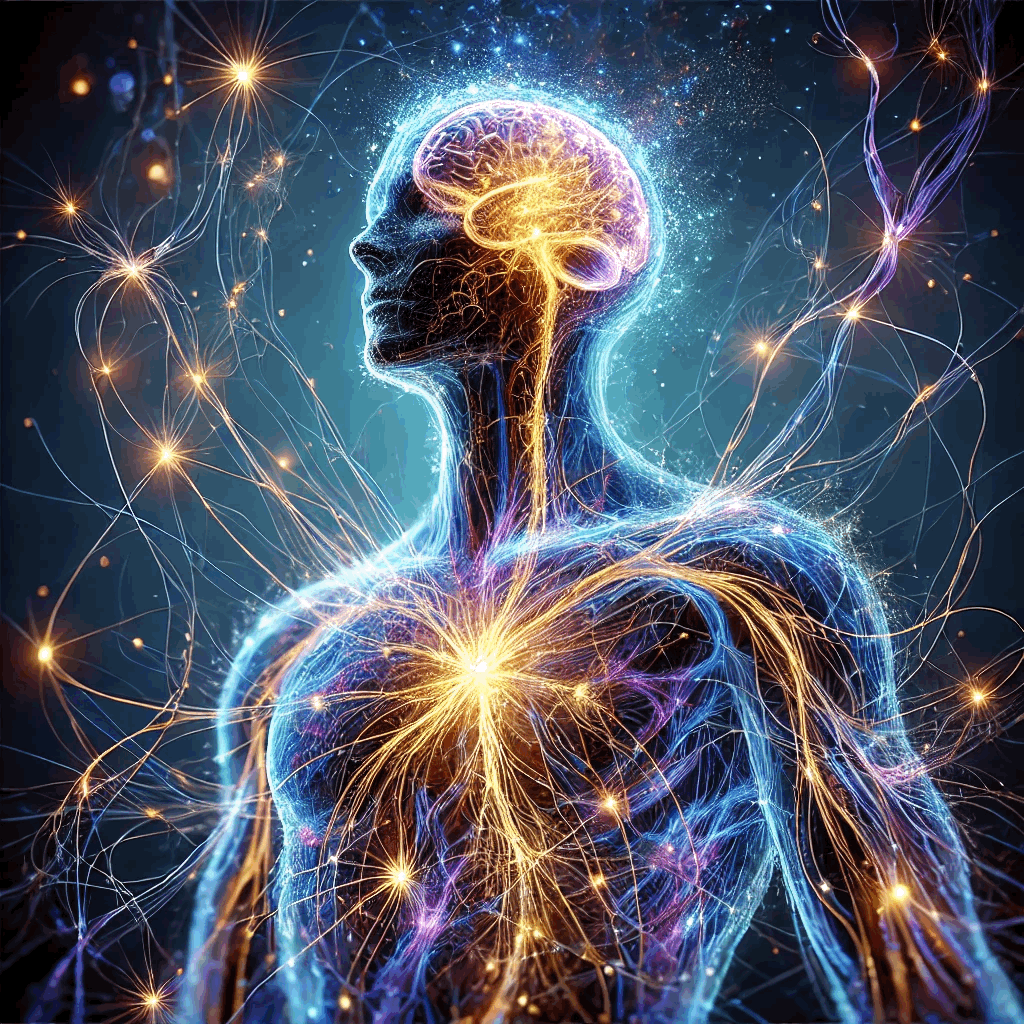
You've probably heard the phrase "what fires together, wires together." It's become popular in wellness circles thanks to Dr. Joe Dispenza, but the concept goes back to neuroscientist Donald Hebb and a foundational rule of how your brain learns: neurons that activate together form stronger connections over time.
Most people hear this and think about positive thinking, or breaking bad mental habits. And that's true. But in my years of working with clients at Human Performance Center, I've seen this principle play out just as powerfully in the body. In how we move, how we experience pain, and how we recover from injury. Understanding this one idea can change the way you approach your own health.
01 — The RuleHow your nervous system learns.
Hebb's Rule is simple: the more frequently two neurons fire at the same time, the stronger the connection between them becomes. Your brain gets faster and more efficient at running that particular circuit.
This is the mechanism behind all learning. Riding a bike, playing an instrument, developing a jump shot. But it's also the mechanism behind things we don't want to reinforce:
Thought patterns.
Repeated anxiety or negative self-talk carves deeper neural grooves, making those responses more automatic over time.
Movement habits.
Compensating for a sore knee by shifting your weight changes the way your entire chain of muscles fires. Do it long enough, and your nervous system treats the compensation as the new default.
Pain responses.
When pain signals fire alongside fear, stress, or guarded movement, those experiences get bundled together. Your nervous system starts treating them as a package deal.
The nervous system doesn't judge. It simply reinforces whatever you repeat.
02 — The LoopWhy pain gets stuck.
This is where things get interesting, and where I see clients struggle the most.
Pain is not just a tissue problem. It's a nervous system event. When you roll an ankle, the damaged tissue sends a signal, your spinal cord relays it, and your brain interprets it as pain. That's the acute phase, and it works exactly the way it should.
But here's what happens when pain persists: the nervous system gets better at producing it. The neurons involved in pain signaling strengthen their connections. Your brain starts anticipating pain before you even move. Muscles tighten preemptively. Stress hormones rise. And now pain is no longer just a report from damaged tissue. It's a learned pattern.
This is called central sensitization, and it's one of the most important concepts in modern pain science. The alarm system that was designed to protect you gets stuck in the "on" position. Clients describe feeling "stuck," and neurologically, that's exactly what's happening.
A trace becomes a path becomes a highway.
The same mechanism that lets you ride a bike without thinking is the one that bakes in a limp, an anxious thought loop, or a chronic pain pattern. The wiring is neutral. What it learns is up to the inputs you give it.
- Wanted patterns — skills, calm, efficient movement. Built by deliberate, repeated input.
- Unwanted patterns — pain loops, compensations, anxiety. Built the exact same way, often by accident.
The tissues may have healed months ago, but the nervous system hasn't gotten the memo.
03 — The RootsEarly life trauma & chronic pain.
Central sensitization explains how pain becomes self-reinforcing. But it doesn't explain why some people develop chronic pain after a minor injury while others recover from major trauma without lasting issues. To understand that, we need to look further back. Often all the way to childhood.
The nervous system doesn't arrive in adulthood as a blank slate. It's shaped profoundly by early life experiences, especially during the first several years when the brain is developing at its fastest rate. During this window, the nervous system is essentially learning what kind of world it lives in: Is it safe? Is it predictable? Can I rely on the people around me?
When a child grows up in a stable, secure environment, the nervous system calibrates accordingly. The stress response develops a healthy threshold. It activates when there's a real threat and settles back down when the threat passes. But when a child experiences trauma — abuse, neglect, household dysfunction, chronic unpredictability, or even sustained emotional absence from caregivers — the nervous system calibrates for danger. The stress response becomes hair-trigger. The baseline shifts toward hypervigilance.
ACEs leave a measurable, biological imprint.
Research on Adverse Childhood Experiences shows that early trauma physically alters the development of the brain and nervous system. The amygdala, which processes threat, becomes overactive. The prefrontal cortex, which regulates emotional responses, may develop with less capacity to calm things down. The HPA axis — your body's central stress machinery — can become chronically dysregulated, pumping out cortisol at levels meant for emergencies, not everyday life.
What does this have to do with pain? Everything.
A nervous system that was wired for threat in childhood doesn't suddenly rewire itself in adulthood. It carries that heightened sensitivity forward. So when that person experiences an injury at age 35 or 45, their nervous system doesn't just respond to the tissue damage. It responds with the full weight of a system that has been primed for danger since childhood. The pain signal gets amplified. The stress response fires harder and longer. The protective guarding is more intense. And the pathway from acute pain to chronic pain is shorter and steeper.
This is why two people can have the same MRI findings, the same disc herniation, the same rotator cuff tear, and have completely different pain experiences. The difference often isn't in the tissue. It's in the nervous system that's interpreting the signal. And that nervous system was shaped by experiences that may have happened decades before the injury.
I see this regularly in our practice. A client comes in with what looks like a straightforward movement or pain issue, but the nervous system's response is disproportionate to what's happening in the tissues. When we start exploring the full picture — not just the physical history but the life history — early trauma is often part of the story. Not always, but often enough that it can't be ignored.
This is not about blame. It's not about saying pain is "in your head." It's the opposite. It's about recognizing that the nervous system is a physical organ shaped by real experiences, and those experiences leave a biological imprint. A child who grew up in chaos didn't choose to have a sensitized nervous system any more than they chose their eye color. But understanding this connection is the first step toward changing it.
Neuroplasticity works here too. The capacity for change is real, and it's available at any age.
04 — The RewireWhat it actually takes.
The same neuroplasticity that created the problem can solve it. If the nervous system learned to amplify pain, it can learn to dial it back down. But it takes intentional, consistent input — not just rest and time. Here's what that looks like in practice.
Pain education.
This might sound too simple, but understanding how pain works is itself therapeutic. Research consistently shows that when people learn that pain is a product of the nervous system — and not necessarily a sign of ongoing tissue damage — their pain levels decrease. Fear drops. Movement increases. The cycle starts to shift. At HPC, this is always our starting point. We want you to understand why your body is responding the way it is before we start changing inputs.
Mindful, graded movement.
The nervous system needs new data. If it's learned that bending forward equals danger, we need to gradually show it that bending forward can be safe. This is called graded exposure — slowly and intentionally reintroducing movements in a controlled way. The key word is intentional. Mindless repetition reinforces whatever pattern you're already running.
Neuromuscular re-education.
This is where our tools come in. Technologies like the Nuex NX PRO 500, frequency-specific microcurrent, and cold laser therapy enhance the communication between nerves and muscles at a level you can't reach through movement alone. Combined with our proprietary IPAT (Integrated Performance and Treatment) approach, these tools allow us to address the full picture — not just the symptom, but the system producing it.
Visualization & breathwork.
Your nervous system doesn't fully distinguish between a vividly imagined movement and a real one. Visualization activates many of the same neural pathways without the physical load, making it a powerful tool for people who aren't yet ready to move through full ranges of motion. Breathwork complements this by directly calming the autonomic nervous system. Slower, deeper breathing shifts you out of the fight-or-flight state that amplifies pain and into a parasympathetic state where healing happens.
Breaking the pain–stress loop.
Chronic pain and chronic stress feed each other. Pain triggers a stress response. Stress heightens pain sensitivity. The loop tightens. Practices like meditation, controlled cold exposure, and biofeedback interrupt this loop by lowering the baseline activation of your stress response. Over time, this creates more space between stimulus and reaction — and that space is where recovery lives.
05 — The PracticeThe five inputs, in order.
Here's how the five rewiring inputs sequence in our work with clients. None of them is optional. The order matters less than the consistency.
Pain education
Understand that pain is a nervous system output, not a tissue readout. Fear drops. Movement opens. The loop loosens.
Graded exposure
Slowly, deliberately reintroduce the movements your system has flagged as dangerous. New, safe data — one rep at a time.
Neuromuscular re-ed
Microcurrent, cold laser, and the Nuex NX PRO 500 — used inside our IPAT framework — to clean up the signaling underneath the movement.
Visualization & breath
Mental reps build the pathway with no load. Slow nasal breathing flips the autonomic switch from threat to repair.
Lower the baseline
Meditation, controlled cold, biofeedback. Drop the resting tone of the stress response so a stimulus doesn't immediately become a flare.
Repeat. For weeks.
The system rewires the same way it got wired in the first place — through repetition. There is no shortcut, and there doesn't need to be.
Tissues heal in weeks. The nervous system rewires in months.
If you've been guarding a movement, dreading a posture, or living with a baseline of tension for years, expect the rewiring to take a season — not a session. The nervous system is patient and stubborn in equal measure. Show up consistently and it will catch up.
06 — The InvitationBoth warning & promise.
"What fires together, wires together" is both a warning and a promise.
It's a warning that our habits — mental, emotional, and physical — can quietly reinforce patterns of pain and dysfunction if we don't pay attention. But it's also a promise that with the right inputs, we can build new pathways. Pathways toward less pain, more efficient movement, and greater resilience.
Your nervous system is always learning. The question is: what are you teaching it? — Fred McDaniel
If pain or movement challenges are holding you back, we can help you retrain your nervous system for lasting change. Book a consultation and let's get to work.