
Your Breath Is the One Part of Your Nervous System You Can Actually Control
The science behind PNEO, the app we built to train the respiratory system, and through that, change the state of the nervous system.
Breathwork · Nervous System · May 2026 · 8 min read
Meet PNEO
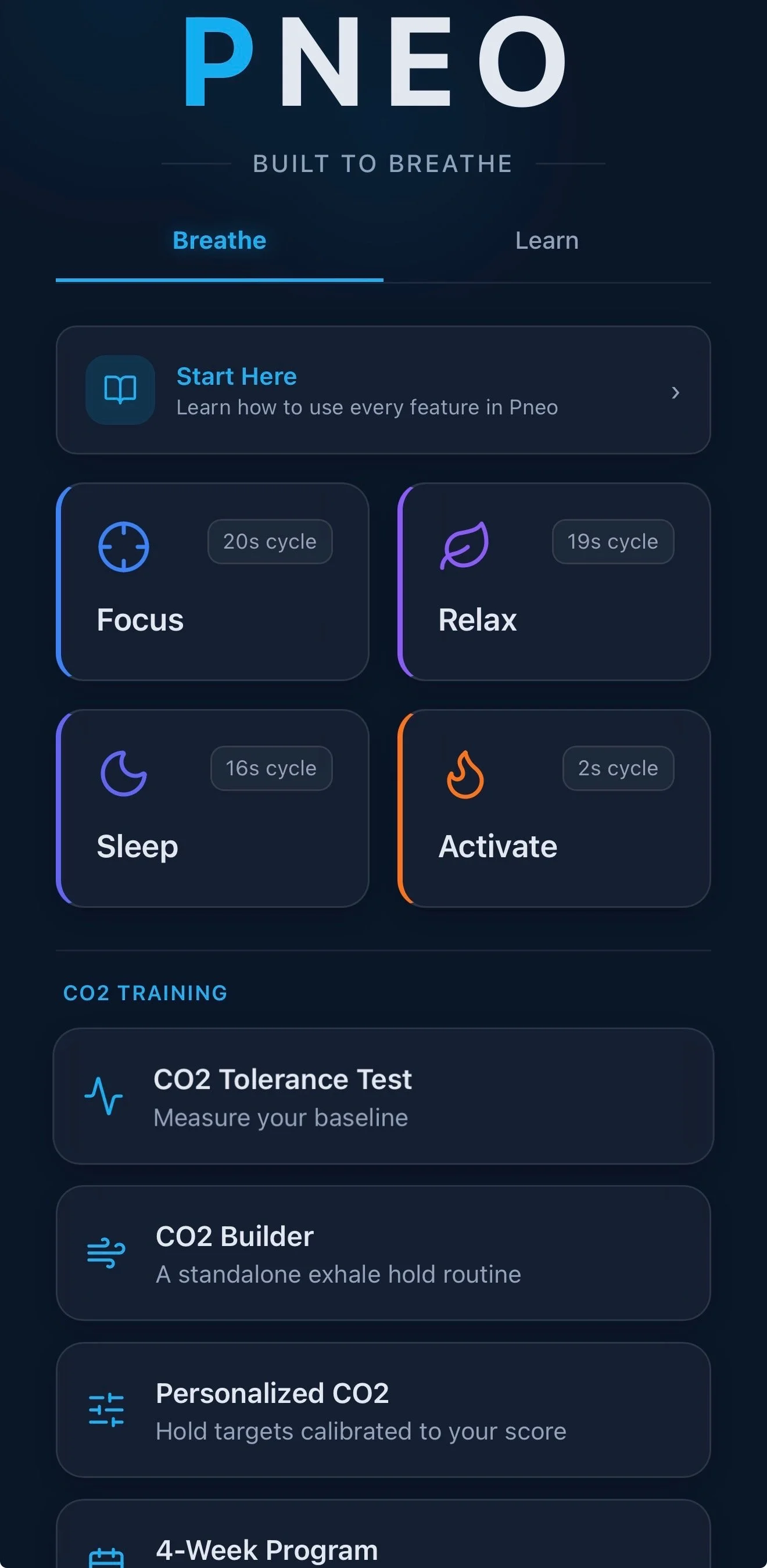
PNEO (pronounced “NEE-oh,” from the Greek word for I breathe) is an app we built at the Human Performance Center to do one specific thing: train your respiratory system in a way that shifts the state of your nervous system. It’s not a library of guided sessions. It measures where your physiology actually sits, gives you four core techniques to train with (Focus, Relax, Sleep, and Activate), and builds a progression that recalibrates to you instead of handing you a generic template.
The rest of this piece is the science underneath. If you’ve ever wondered why slow nasal breathing actually changes how you feel, why a single long exhale can drop your heart rate before you even finish it, or why most breathwork advice quietly skips over the chemistry side of the equation — this is the anatomy. It’s also the reason we built PNEO the way we did, and why it starts with a measurement instead of a meditation.
The PNEO home screen
If you arrived from the May newsletter, this is the deep dive we promised. If you found it on its own, the daily practice is over there.
What “master signaler” actually means
Your autonomic nervous system runs thousands of processes you can’t consciously control. Heart rate, digestion, hormone release, immune response. You can’t will your heart to slow down or tell your stomach to work faster.
Breathing is the exception. It runs on autopilot 20,000 times a day, but you can take over any time. No other autonomic function gives you that kind of direct access.
That makes breath the one input you can consciously rewrite. It’s always broadcasting your state to your body, and it’s the only autonomic channel where you get a say. That’s the reason PNEO exists. If you’re going to train one input that talks to everything, this is the one.
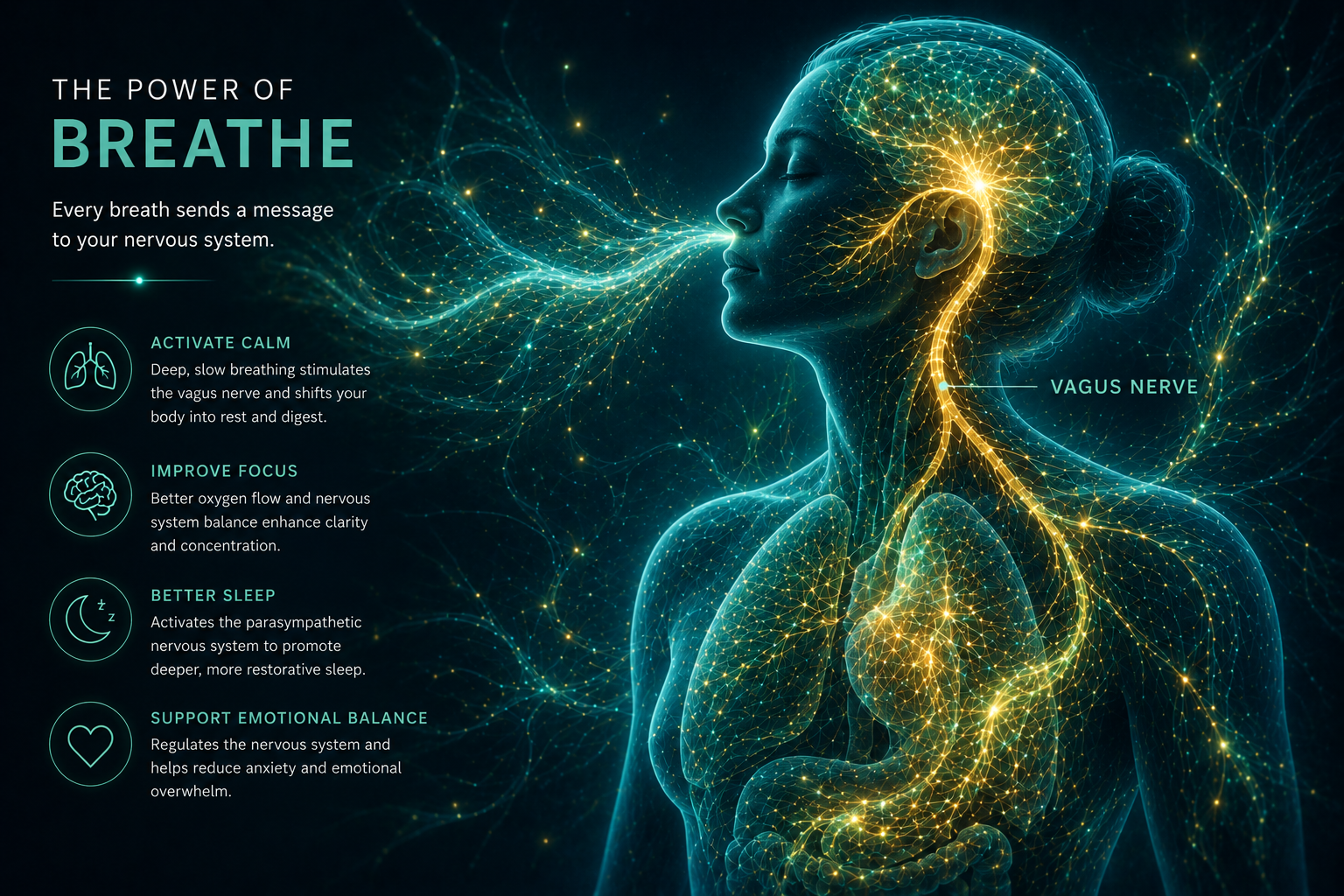
Your body is always listening to your breath. The wire it listens through is the vagus nerve, the longest nerve in the body, running from your brainstem down through your neck to your heart, lungs, diaphragm, and gut.
Most people think of nerves as the brain sending orders out. Move this finger, lift this arm. The vagus nerve mostly works the other direction. About 80% of its fibers carry information up from the body to the brain. Your brain is constantly reading these signals to decide what state to put you in, and breath is one of the loudest.
Three sensors, one question
There are three sensors involved, and each one reads a different thing about your breath.
Baroreceptors — your pressure sensors
These sit in the walls of the big arteries in your neck and just above your heart. They feel how much push there is in the system. Every time you take a slow, full breath, you change the pressure inside your chest, and these sensors notice. They send a signal up the vagus nerve that tells your heart to slow down a beat. That’s why one long exhale can drop your pulse before you even finish the breath.
Chemoreceptors — your chemistry sensors
Some sit in your brainstem, some sit in those same neck arteries. Here’s the twist most people get wrong: they’re not watching for low oxygen. They’re watching for rising CO2. When CO2 climbs past what they’re used to, they fire the alarm. Breathe now. If your tolerance is low, that alarm goes off way too easily, and you end up taking a fast, shallow breath every few seconds just to keep things quiet. That’s the loop that keeps so many people stuck in low-grade anxiety all day.
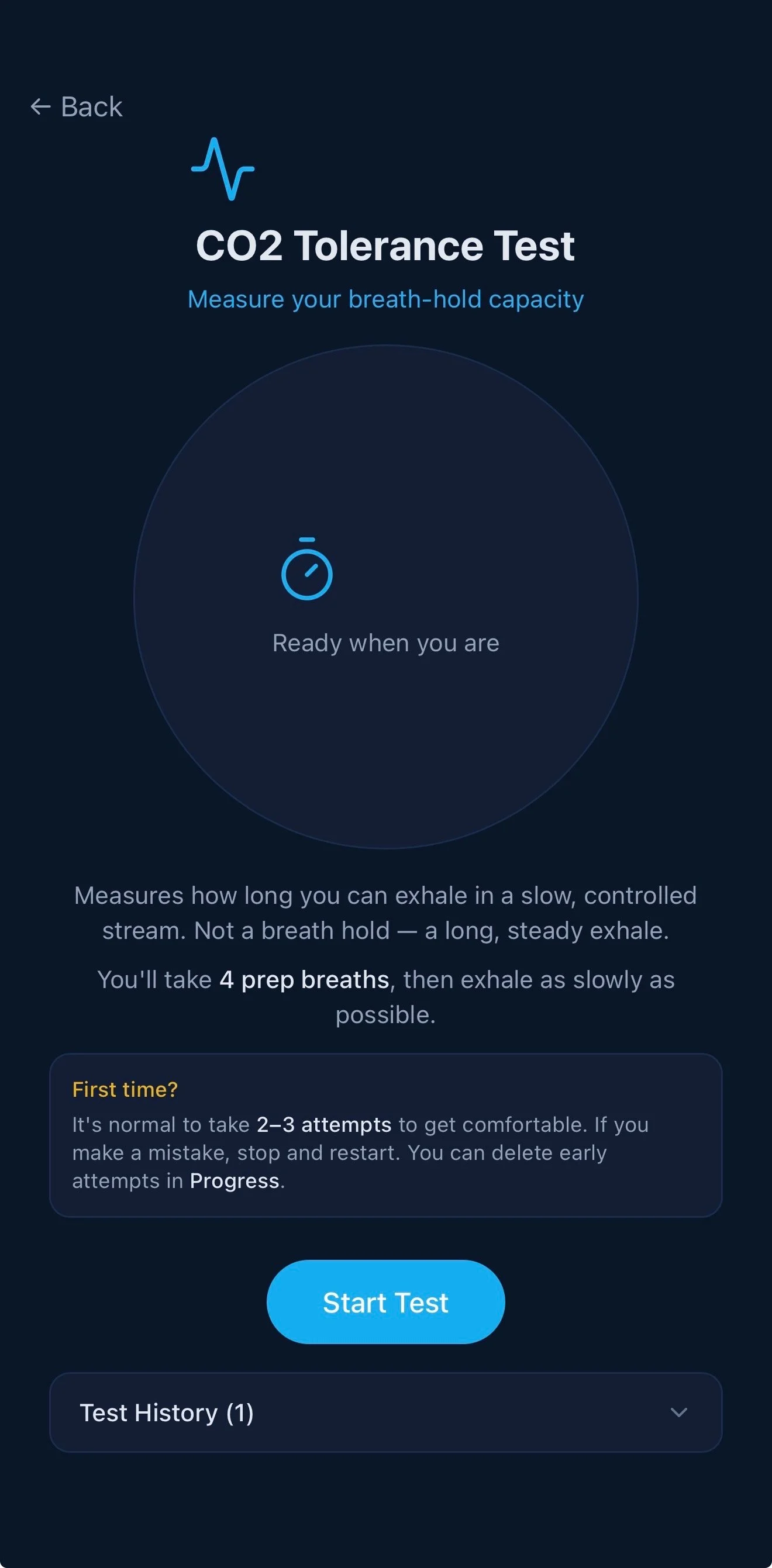
This is also why we built PNEO around a CO2 tolerance test before anything else. Until you know where your tolerance actually sits, you can’t tell whether a slow-breathing protocol is going to feel like relief or like a fight. The test gives you an objective number to start from, and everything else in the app calibrates off it.
The CO2 Tolerance Test
Mechanoreceptors — your stretch sensors
These are wired into your lungs, your airways, and your diaphragm. They feel how you’re breathing. Whether your diaphragm is doing its job and the whole midsection is expanding, or whether you’re just puffing your chest a few inches. A full belly-and-back breath sends a completely different message up the vagus nerve than a shallow shoulder shrug, even if the air volume is the same.
All three feed into the same place in your brainstem, and your brain blends them into one question: do I need to run from something, or am I safe to rest?
You’re answering that question with every breath, whether you mean to or not.
“Fast and shallow reads threat. Slow and nasal reads safe. Same body — two completely different signals.”
Why breath and not something else
Breath has two control systems stacked on top of each other. An automatic brainstem loop and a voluntary cortical override. That dual wiring is rare in the body.
It’s the single access point between your conscious mind and the autonomic machinery running underneath it. Cold plunges, meditation, HRV training, vagus nerve stimulation — they’re all trying to reach the same place breath reaches directly.
That’s why we keep coming back to it in the lab, and why PNEO is the project we’ve put the most time into this year. When someone walks in stuck in chronic pain, poor sleep, or low-grade anxiety, we can spend months working the periphery, or we can train the one input that talks to all of it at once.
The signal goes both ways
Most breathwork content stops at the single-session level, and that’s where it falls short.
A single slow exhale is a single message. It will shift your state for a few minutes. Useful, but limited.
What matters more is the pattern of breath you hold at rest — the one you’re not thinking about. That’s a constant broadcast. And your nervous system treats it as baseline truth.
Resting at 16 breaths per minute, shallow, mouth-dominant: default state reads “mild ongoing threat.” Resting at 5 to 6 breaths per minute, nasal, long exhale: default state reads “safe and regulated.”
Change a single session and you change an afternoon. Change the resting pattern and you change what “normal” feels like.
Retraining the resting signal is the whole reason PNEO exists. A daily session shifts your state temporarily. The progression inside the app shifts the baseline underneath, so what your nervous system reads as “normal” slowly moves toward “regulated.”
“Most people have been broadcasting a stress signal for years and wondering why they can’t sleep — or can’t drop out of fight-or-flight no matter how much they meditate or supplement.”
This is what we mean by your inside voice. The quiet, constant message your breath sends to the most automatic parts of your nervous system, looping back into the state your breath then reflects.
The skill of sensing that signal in your own body has a name: interoception. The ability to notice what’s happening inside you before it shows up as a feeling, a mood, or a symptom. Once you can feel it, you can answer it.
What you actually train
Three levers shift the resting signal.
When all three shift, the default your nervous system reads as true shifts with them. PNEO trains all three, with the CO2 tolerance test as the starting point and the progression timed to your physiology.
How PNEO fits
I built an app to train the respiratory system, which changes the state of the nervous system. What makes it unique is that anyone who breathes can benefit from it — from someone dealing with respiratory challenges to elite athletes. All it takes is about 5 minutes a day.
— Fred
The core of PNEO is free — the CO2 Tolerance Test, all four breathing techniques, and the ability to tune each one to your physiology. Where it goes further is Pro: training that calibrates directly to your CO2 test score and builds a progression around it. No other breathwork app does this. Most hand you a session and hope it fits. PNEO measures where you are and meets you there.
Inside the app
- CO2 Tolerance Test — the chemoreceptor measurement. Two minutes of guided exhale, one number that tells you where your alarm is currently set.
- Focus, Relax, Sleep, Activate — the rate and route levers. Each one is built around a specific nervous system goal, and each one is tunable. All four are in the free version.
- Personalized CO2 Training Pro — the chemistry lever trained over time. It moves your tolerance progressively so slower breathing becomes sustainable instead of a struggle.
- 4-Week Program Pro — raises the floor of what your nervous system treats as normal, week by week.
PNEO is in closed beta this month, with an official release in June on the Apple App Store. The May newsletter has Fred’s full note on why he built it, plus how to grab one of the 10 beta spots we’re opening to readers. Android is on the way.
Where to go from here
Your breath has been signaling your state to your body your entire life. The question is whether you want to keep broadcasting whatever pattern you picked up by accident, or send one you chose.
The two-minute 4-7-8 reset in this month’s HPC newsletter is the easiest first move. No app, no device, just a closed mouth and a timer.
The CO2 tolerance test inside PNEO is the second. Two minutes, an objective number, and a clear starting point.
Breathe well,
Fred McDaniel
Human Performance Center · Santa Fe, NM